

Creating a contact
Select New Lead in Audience to open the New contact form. A name is optional; a phone number or an email address is required — either one on its own is enough. Both must be unique in the workspace, so if a value already belongs to another contact, the form flags the match and offers to open that contact or add the missing detail to it instead of creating a duplicate.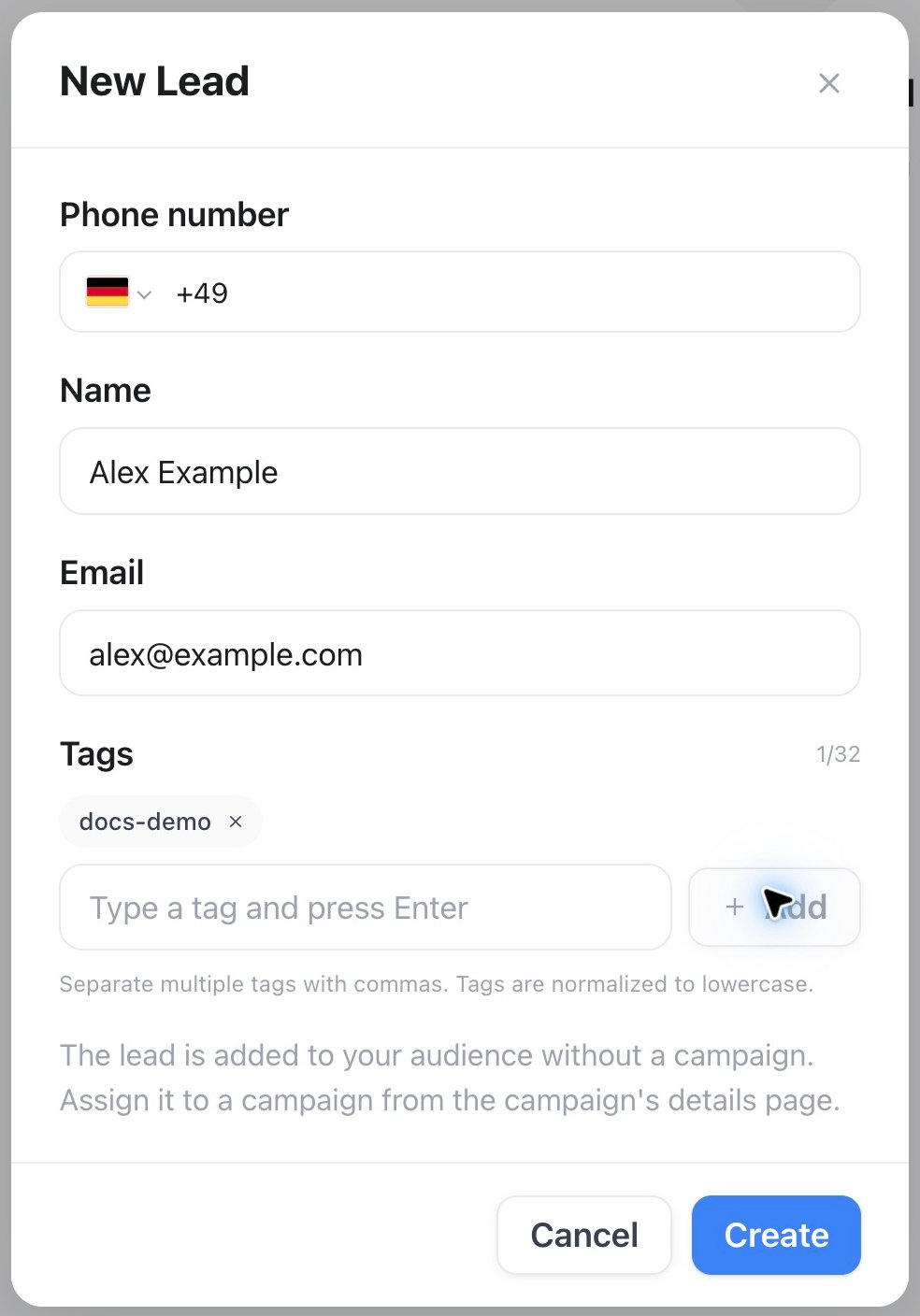
Audience — unsaved New Lead form with fictional example details
Editing a contact
Open a contact to see three tabs:- Overview — segments, last contacted, Call QA average (where AI QA scorecards are enabled), personal details, custom attributes, and any linked channel profiles.
- Memory — consent-aware customer memory and verified identities gathered across channels.
- Timeline — every call, message, and email for this contact, with a link into History for the full record.
Tagging, filtering, and saved segments are covered in Audience Call QA — this page focuses on the contact record itself.
Custom attributes
Define workspace-wide fields under Settings → Workspace → Custom Attributes: a name, a type, and whether it’s required. The types are Text, Number, Boolean (a yes/no field), Enum (a list of choices you define), and Date. The attribute’s key is generated from the name — “Maiden Name” becomesmaiden_name — and the type is fixed once the attribute exists.
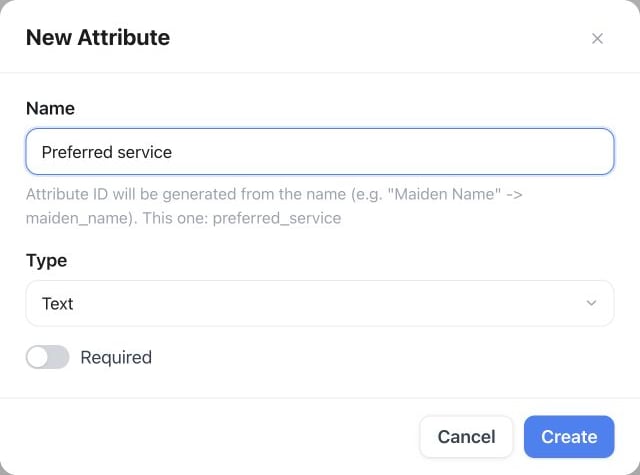
Settings → Custom Attributes → New Attribute: name the field, choose its Type, decide whether it is Required and select Create.
{{key}} on every call with that contact. See Custom variables.
Contact status
Every contact carries one status, driven by its most recent campaign activity:
Filter Audience by status to find contacts in any of these states. The same six states drive the drag-and-drop board inside a campaign, where the columns carry campaign-facing names — see Monitoring a running campaign.
Merging duplicate contacts
Phone numbers and email addresses are unique per workspace, so Famulor never lets a second record claim an identity that already exists:- On create — adding a single contact whose phone or email already belongs to someone else merges the new tags and fills in any missing identity fields on that contact, instead of creating a second record. This applies to the New contact form,
POST /api/v1/leads, and MCPcreate_audience_contact. - On edit — if you change a contact’s phone or email to a value already used elsewhere, the Info tab flags the collision and offers Merge into this contact. Merging moves phone, email, channel identities, calls, and conversations onto the contact you keep and removes the other record.
- On import — bulk imports never merge. A CSV row or campaign lead whose phone or email is already taken is rejected rather than folded into the existing contact, so deduplicate against Audience before a large import. See Importing contacts.
POST /api/v1/leads/{id}/merge or the MCP tool merge_audience_contacts.
Deleting a contact
Delete a contact from More actions in its drawer. This removes the contact record permanently and cannot be undone. Taking a lead out of a campaign is a different, non-destructive action: the lead leaves that campaign’s queue, and the contact — with its calls, conversations, and history — stays in Audience.API & MCP
connection_name is the public selector used by the API and MCP. Reconnected copies of the same Microsoft identity are normalized to one current connection name.
MCP clients can use list_audience_contacts, create_audience_contact, list_audience_contact_channels, replace_audience_contact_channels, and merge_audience_contacts for the workspace-wide contact list. get_lead, update_lead, and delete_lead work on a campaign lead rather than the Audience record — and delete_lead only takes the lead out of its campaign; the contact stays in Audience.