

Write clear edge labels
Write edge labels as clear conditions from the caller’s perspective:- ✅
caller confirms they are an existing customer - ✅
caller wants to cancel or reschedule - ❌
yes,path A,continue
Keep agents small and single-purpose
One agent = one job (qualify, answer billing questions, book). Short, focused instructions per agent outperform one mega-agent with a wall of text. Handoffs are cheap — use them.Validate data with collect nodes, not prompts
Emails and phone numbers transcribed from speech are noisy.collect nodes confirm and validate (“Was that m-e-y-e-r?”) and only proceed on success. Always name the variable clearly (callback_phone, not var1) — those names surface in webhooks and call details.
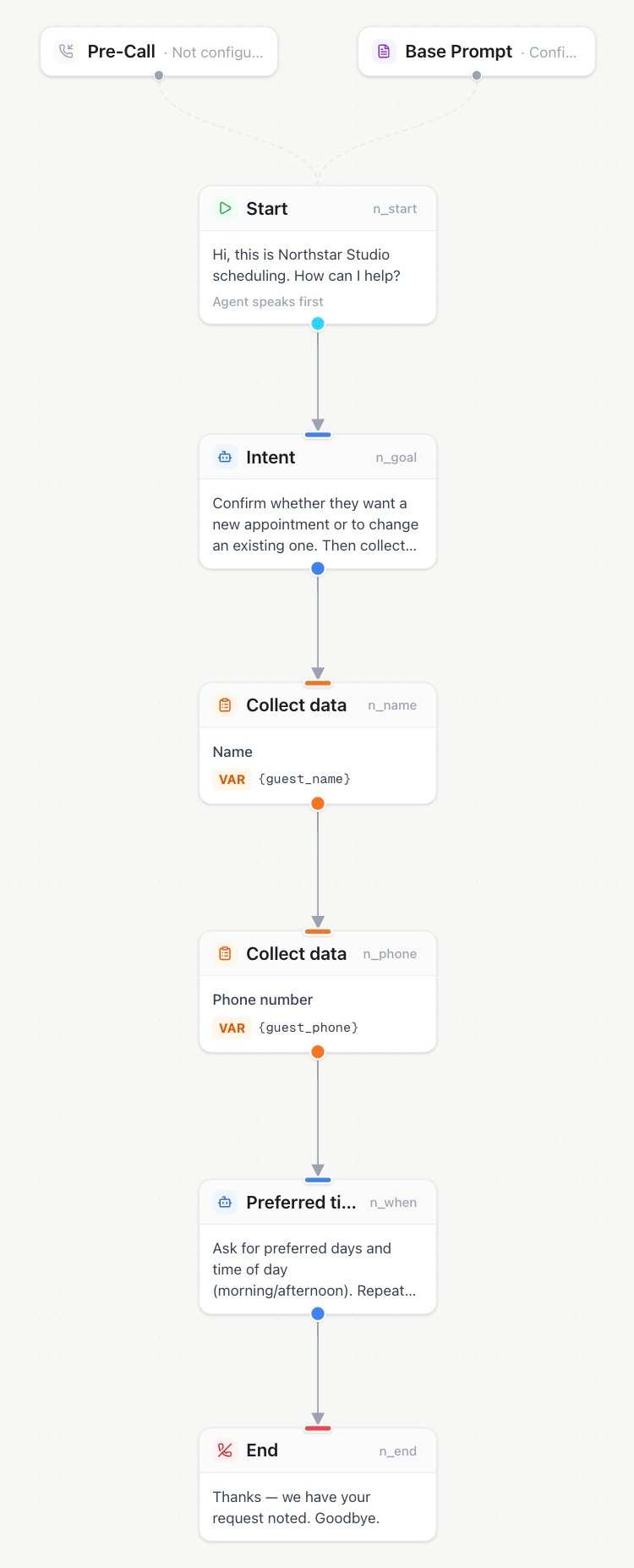
In the Flow builder, use separate Collect data nodes for Name and Phone number, each with its own named variable.
Design the failure paths
- Give
collectnodes afailededge that leads somewhere sensible (a human transfer or a polite goodbye). - Set warm-transfer
fallbackdeliberately:continuefor optional handovers,cold_transferwhen the caller must reach someone. - End every branch with an
endnode with a proper farewell.