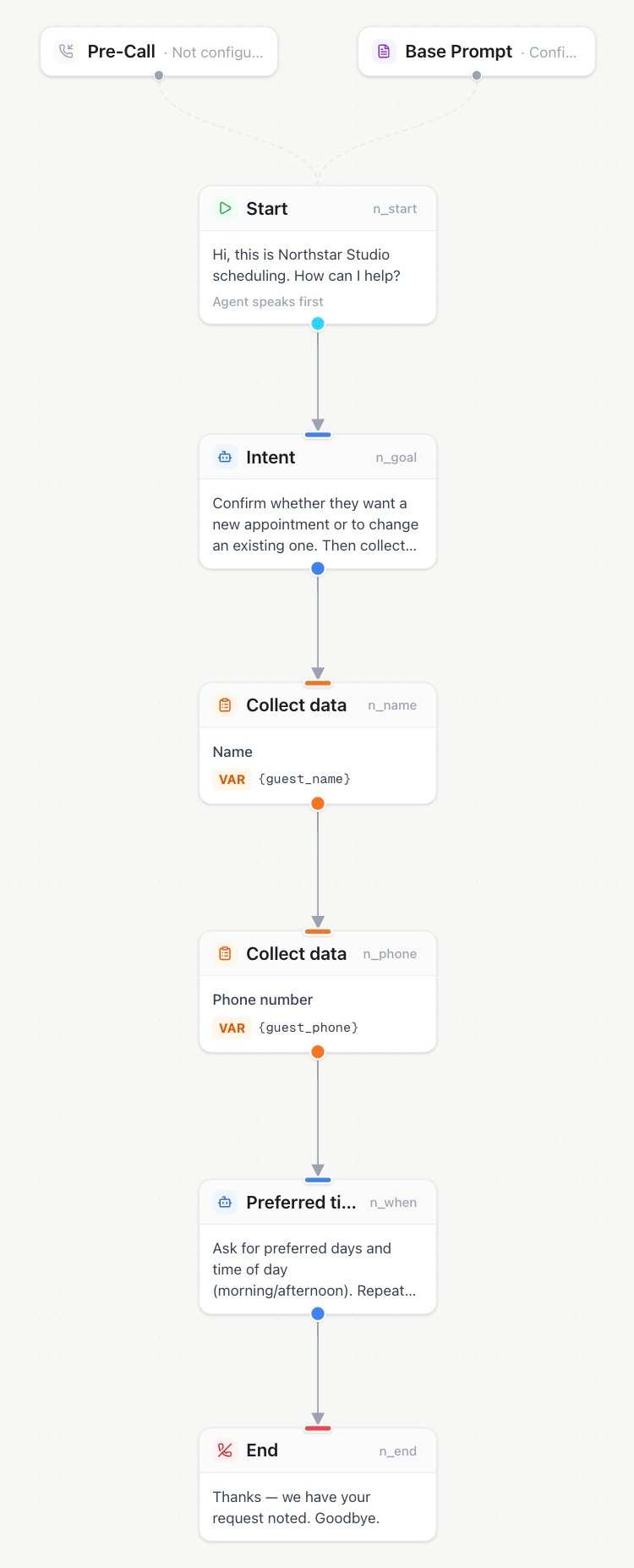
The Flow Builder is a visual drag-and-drop editor for conversation flows that lets you design scripts for AI assistants without writing code. Create multi-step conversation flows by connecting nodes that represent different actions and decision points.

Overview

The Flow Builder offers:
  • Visual design – Drag and drop nodes on a canvas
  • Multiple node types – Messages, prompts, actions, and more
  • Branching logic – Create different paths based on responses
  • Settings panel – Configure the agent’s personality and behavior
  • Import/Export – Save and share flows as JSON files
Flow Builder User Interface

When to Use the Flow Builder

Use the Flow Builder for

  • Structured conversation scripts
  • Multi-path decision trees
  • Complex call flows with branching
  • Visual thinkers who prefer diagrams

Use the Classic Editor for

  • Simple, linear conversations
  • Highly dynamic AI responses
  • Rapid prompt iterations
  • Text-focused editing

Getting Started

1

Open Assistants

Navigate to Assistants and click the assistant you want to edit.
2

Find the Flow Builder

Scroll to the System Prompt section in the edit form and click the Flow Builder tab.
3

Launch the Flow Builder

Click Start Flow Builder. A fullscreen editor will open.
4

Choose a start mode

  • Continue with existing – Edit your current flow
  • Start from scratch – Begin with only a start node
  • Start with template – Load a pre-built flow template

Interface Overview

Canvas Area (Center)

The main workspace where you build your flow:
  • Nodes – Drag to reposition
  • Connections – Lines showing flow between nodes
  • Grid background – Helps with alignment
  • Zoom controls – Zoom in/out and fit to view
  • Pan – Click and drag empty space to move around

Bottom Toolbar

Quick actions for managing your flow:
ButtonAction
⚡ Auto LayoutArrange nodes neatly automatically
📋 DuplicateCopy the selected node
🗑️ DeleteRemove selected node or connection
+ Add NodeAdd a new node to the canvas

Settings Panel (Right Side)

Configure your assistant’s personality and behavior:
  • Agent Name – The name your AI will use
  • Agent Type – Sales, Support, Survey, etc.
  • Language – Spoken language for calls
  • Assertiveness – How persistent the AI should be
  • Humor – Level of humor in responses
  • Variables – Pre-call data fields
  • Post-Call Fields – Data to collect after calls

Node Types

The Flow Builder includes 5 node types, each serving a specific purpose:
Flow Builder Node Types

Start Node (Green)

Start Node

The entry point of every conversation. Each flow must have exactly one start node.Properties:
  • Greeting – The first message when the call begins
Example: “Hello, this is Sarah from Famulor. How are you today?”

Speak Node (Blue)

Speak Node

Outputs a predefined message exactly as specified. Use this node when you need precise wording.Properties:
  • Text – The exact message to be spoken
  • Outcomes – Different paths based on customer response
Example: “We are currently offering a limited 20% discount on all plans. Would you like to learn more?”

Prompt Node (Purple)

Prompt Node

Gives the AI instructions on how to respond. More flexible than Speak nodes — AI generates context-aware replies.Properties:
  • Prompt – Instructions for the AI
  • Outcomes – Different paths based on response categories
Example prompt: “Ask the customer about their current insurance coverage. Be conversational and empathetic. Listen for mentions of family size, budget concerns, or timing.”

Action Node (Orange)

Action Node

Performs special actions during the call.Action Types:
  • Call Forward – Forward to another number
  • Schedule Appointment – Book via a linked calendar
  • Custom Action – Trigger a custom mid-call tool
Example: Forward to the sales team at +49-555-123-4567 if the customer is ready to buy.

End Node (Red)

End Node

Ends the call or transfers to another destination.End Types:
  • End Call – Hang up with a closing message
  • Forward Call – Forward to a phone number
  • Agent Transfer – Hand off to another assistant
Example closing: “Thank you for your time today. Have a great day!”

Working with Nodes

Adding Nodes

  1. Click + Add Node in the bottom toolbar.
  2. Select the node type from the dropdown menu.
  3. The node appears on the canvas.
  4. Drag it to your desired position.

Connecting Nodes

  1. Hover over the bottom edge of a node to reveal the outbound port (small circle).
  2. Click and drag from the outlet.
  3. Connect it to the inbound port on the top edge of another node.
  4. Release to create the connection.

Editing Nodes

  1. Click any node to select it.
  2. Its properties show up in a panel.
  3. Edit text, prompt, or settings as needed.
  4. Changes are saved automatically on the canvas.

Deleting Nodes

  • Select a node and press the Delete key, or
  • Select a node and click the 🗑️ button in the toolbar.
The start node cannot be deleted. Each flow must have a start node.

Outcomes (Multiple Paths)

Speak and Prompt nodes can have multiple outcomes – separate paths depending on the customer’s response.

Adding Outcomes

  1. Select a Speak or Prompt node.
  2. In the properties panel, find the Outcomes section.
  3. Click Add Outcome.
  4. Name the outcome (e.g., “Interested”, “Not interested”, “Request callback”).

Connecting Outcomes

Each outcome appears as a colored dot at the bottom edge of the node. Connect each outcome to a target node to create branching logic.
Conversation branching with outcomes
Example flow:
[Start] → [Ask about interest]

         [Prompt: "Ask if interested"]

     ┌─────────┼─────────┐
     ↓         ↓         ↓
[Interested] [Maybe] [Not interested]
     ↓         ↓         ↓
[Book demo] [Send info] [Thank & End]

Settings Panel

Flow Builder Settings Panel

Agent Identity

SettingDescription
Agent NameName the AI uses to introduce itself
Agent TypePreset personality: Sales, Support, etc.
LanguagePrimary language for the conversation

Personality

SettingOptionsDescription
AssertivenessLow / Medium / HighHow persistent the AI is
HumorOff / Low / Medium / HighLevel of humor in replies

Variables

Add pre-call data that can be used in your messages:
  1. Click Add Variable.
  2. Enter a Name (e.g., product_interest).
  3. Set a Default Value.
Use variables in messages with curly braces: {variable_name} Example: “Hello , I see you have shown interest in our .”

Post-Call Fields

Define data to be extracted from calls:
  1. Click Add Field.
  2. Enter Name, Type, and Description.
  3. The AI will try to fill these fields based on the conversation.
Types: string, number, boolean

Import/Export

Exporting Your Flow

  1. Open the settings panel.
  2. Scroll down.
  3. Click Export JSON.
  4. Save the .json file.

Importing a Flow

  1. In settings, click Import JSON.
  2. Select your .json file.
  3. The flow will load on the canvas.
Regularly export your flows as backups. This also makes sharing flows with team members easy.

Voicemail Settings

Configure what happens when voicemail is detected:
  • Voicemail Message – Message to leave when voicemail answers
  • End call on voicemail – Toggle to hang up automatically on voicemail

Saving Your Flow

Click the Save button in the top right to save your flow within the assistant.
The flow is stored as JSON in your assistant’s system prompt field. When you switch to the Classic Editor, you will see the raw JSON data.

Best Practices

Start Simple

Begin with a simple flow and gradually add complexity. Test at each step.

Use Prompt Nodes

Prompt nodes give the AI flexibility. Use them for dynamic, context-aware responses.

Plan Outcomes

Outline main paths first: positive, negative, and neutral responses.

Test Thoroughly

Make test calls that cover all paths. Verify that each outcome leads to the correct target.

Troubleshooting

  • Make sure you are dragging from an outbound port (bottom) to an inbound port (top).
  • Check that you are not creating a circular connection.
  • Start node has only one output; End node has only one input.
  • Check your internet connection.
  • Ensure you have at least one node besides the Start node.
  • Look for validation errors in the settings panel.
  • Use Speak nodes for exact wording requirements.
  • Make instructions in Prompt nodes more specific.
  • Ensure outcomes are clearly defined and connected.